Introduction
The connection between mathematics and daily life is beautifully illustrated in Maya textiles, where weavers traditionally set 260 counts of 20 on the loom to prepare the warp. This numbering of threads is both functional and symbolic: the value 20 aligns with their vigesimal (base-20) counting system, representing the fingers and toes of a "whole person," while the value 260 mirrors the span of the sacred calendar and human gestation.
The Maya identified numeric patterns throughout their environment, recognizing that specific numbers are omnipresent in the human body, the stars, the local botany, and even axial geometries. By recognizing these recurring patterns, the Maya ascribed deeper meaning to the numbers based on the very things they enumerated. In this way, a number became a distinct personality represented by physical realities it defined.
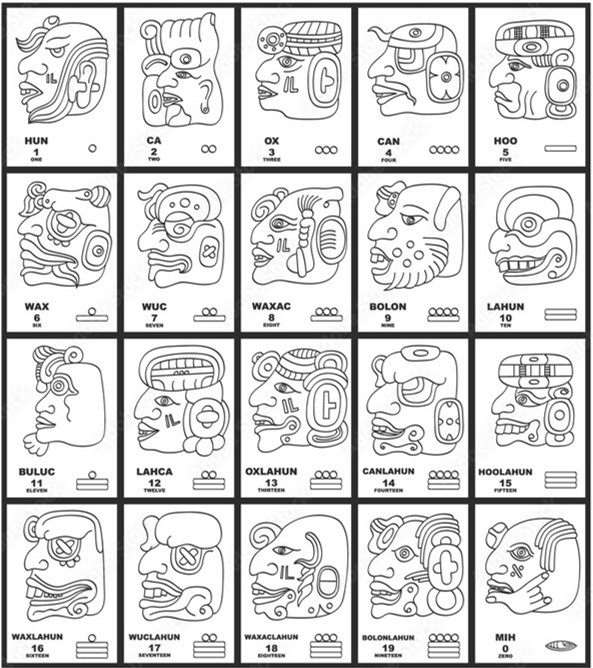
This personification is most visible in ancient writing. While scribes favored the practical bar-and-dot system for daily records, they employed "head variants" and full-bodied figures for sacred inscriptions. These patron gods were chosen because their mythologies embodied the spiritual essence of that number.
To understand Maya numbers, it helps to know they tracked the 13 sacred tones (representing spiritual energy and cosmic time) and the 20 base digits (representing the physical world and human anatomy). Together, these two tracks multiplied to create the full calendar which was then projected onto celestial cycles to understand larger numbers and the orbits of planets.
The Energy of the Count
In the Tzolkin (the 260-day sacred calendar), the 13 numbers are categorized by their "intensity," mirroring the stages of human growth and the movement of energy.
- 1–4: Soft / Emerging These represent the "tender" or youthful state. Like a seedling breaking through soil, the energy is full of potential but still delicate and "weak" in its physical manifestation.
- 5–9: Balanced / Mature This is the peak of the count. These vibrations are considered stable, productive, and firm—the "middle age" of the cycle where the energy is most reliable
- 10–13: Strong / Dangerous These are "transcendental" energies. The power becomes so intense it begins to "strip away the flesh," entering the skeletal realm of the ancestors. These numbers deal with raw, transformative cosmic forces.
To fully grasp this cycle, we must look at the individual identities of the numbers from completion to ascension.
The Base Digits
Zero
The Shell: The most common symbol for zero is a shell or seed husk. It is the empty container that remains after the mollusk within the shell has passed, or the husk left behind after a seed has sprouted. Mathematically, it signifies that a specific numerical tier has reached its absolute capacity. The vessel has been fully "emptied", clearing the way for a new seating.
The Hand on the Jaw: Another variant for Zero is a portrait where a hand covers the lower jaw. Since the jawbone gives a number its "force" (fleshed for 1–12, skeletal for 13+), covering the jaw signifies the absence of one—the necessary pause and moment of rest before the count restarts at One.
One
Deity: The Tonsured Maize God.
Meaning: The number one is the singular kernel, the "First Father." His elongated head is a stylized representation of a maize ear. In the Classic period, Maya elites practiced cranial modification on infants to mimic this shape, physically embodying the "beginning" and the sacredness of the crop. Murals at San Bartolo depict the Maize God in his "First Emergence," sprouting from a turtle carapace (the Earth). He is Hun Hunahpu, whose death and rebirth in the Popol Vuh provide the blueprint for human life. He represents the generative source that must be "buried" (planted) to produce abundance.
Two
Deity: The White Maiden.
Meaning: Two represents complementarity and the necessary tension of opposites. The portrait for two is a white maiden, often shown carrying a bundle on her head. She embodies femininity, the night, the whiteness of the north, and the "otherness" required for creation. Without two, there is no perspective or duality.
Three
Deity: The God of Wind or breath god.
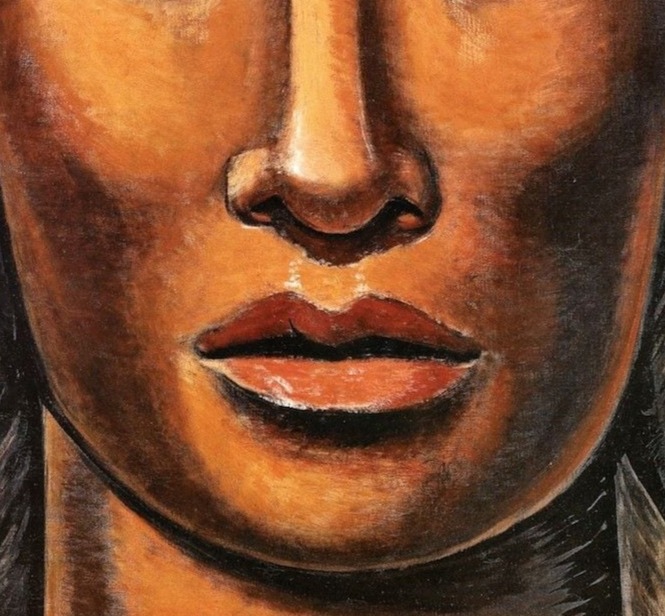
Meaning: The number three signifies the hearth and the breath. Every household is centered on three hearthstones, a configuration that mirrors the three primordial stars of Orion. The three hearthstones stabilized the pot or tray used for cooking, while the vital gaps between them allow air to sustain the flame inside, establishing three as the number of the spirit. This symbolism is also found in human anatomy, represented by the three orifices used for breathing: the nostrils and the mouth. While the Maya pantheon generally favors bipartite or quadripartite structures, the deity Huracan (the etymological root of "hurricane") remains a significant exception. Known as the "Heart of the Sky," Huracan represents a trinity of lightning, thunder, and wind.
Four
Deity: K’inich Ahau (The Sun God).
Meaning: Four represents the Sun and its four stations on sunrise, zenith, sunset, and nadir. It is also the number of vertices needed for "totality" on a horizontal plane and represents the corners of the milpa (cornfield), and --more broadly-- the horizon. Anatomically, four is the structure that allows humans to orient themselves on the ground (anterior, posterior, right and left laterals). The K’in glyph that represents the sun is biologically symbolized as a four-petal flower. One can find many species of these four-petaled flowers growing throughout the Maya region.
Five
Deity: Pawahtun.
Meaning: Five is the quincunx—a shape made of four outer corners and one center point as seen in modern cultures as the arrangment of pips on the casino dice face for five. In human anatomy, five is the completed hand and forms the foundational block (or dash) of their base-20 counting system. In the physical world, the quincunx dictated how the Maya farmer prepared a traditional milpa (cornfield). They measure a square and plant the seeds in a five-point pattern with the four cardinal corners and one seed in the exact center. The fifth seed in the center was the most important, representing the axis mundi or the World Tree that connects the Underworld, the Earth, and the Sky. Astronomically, five is the number of complete Venus synodic cycles that take place with almost perfect harmony within eight solar years. Five is personified by Pawahtun, an aged god often shown carrying the sky on his back.
Six
Deity: Chaac (The Rain God).
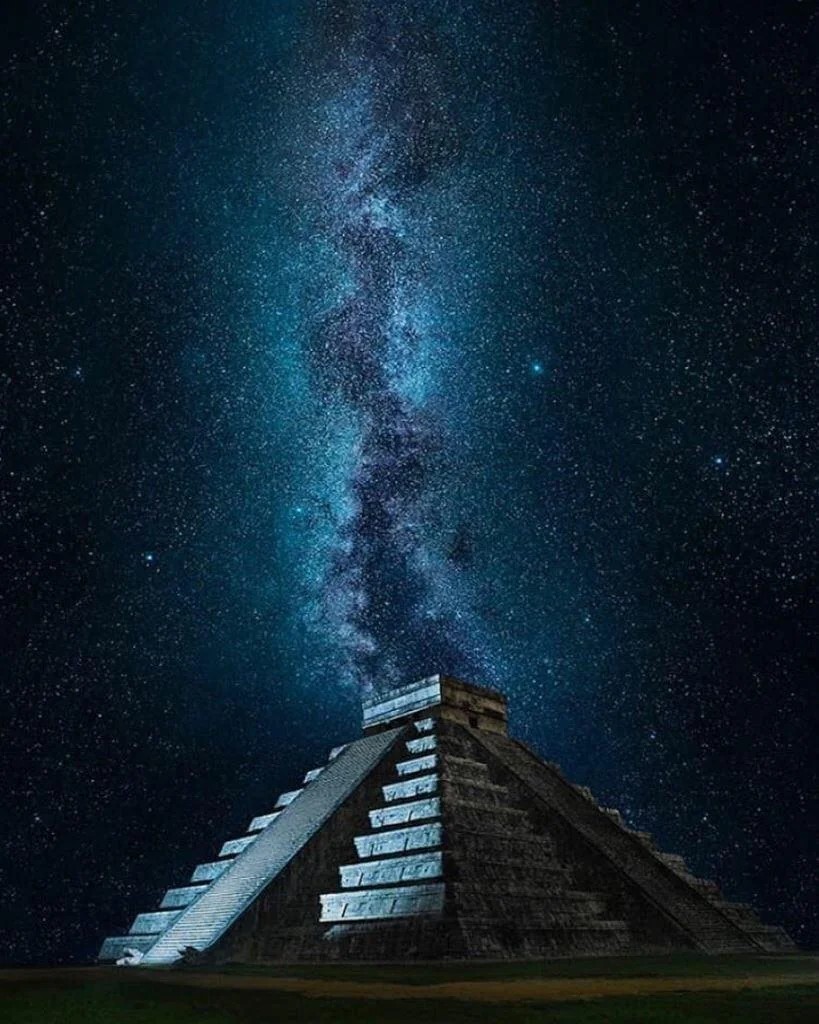
Meaning: Six represents the vertical axis. In Mayan languages, the word for six is Wak, a linguistic verb for "erect" or "to raise up." It represents the moment the Milky Way (Wak Chan) stands upright in the sky. Other symbols for the vertical axis include the ceiba tree and falling rain. While 4 represents the vertices on a flat plane, 6 represents the vertices in complete 3D space (North, South, East, West, Zenith, and Nadir). Chaac’s rain is immersive; it falls from the clouds (Zenith) to the ground (Nadir). Chaac also controls the height of the six-month rainy season in the Yucatan tropics.
In the popul vuh, the six houses of the night were viewed as struggles for the Maya hero twins—and the sun and moon—as they journeyed through the dark.
Seven
Deity: Xbalanque (The Jaguar God of the Underworld).
Meaning: Seven represents the sun in descent or sunset, when the jaguar is most active. It is the exact center of the 13-tone count—the "Spark" or the "Pivot." In Maya time-keeping and a twelve-hour interval, 1 is dawn (beginning), 4 is noon (K’inich Ahau), and 7 is sunset: the moment the sun "changes its skin" and becomes the Jaguar to travel through the Underworld. Seven is also associated with the red and orange colors created at sunset when filtered through the horizon’s atmosphere. The glyph for 7 features a "loop" around the eye, the symbol for fire-drilling. Seven strikes the spark at dusk as the light fades, preparing for the night.
Eight
Deity: The Foliated Maize God.
Meaning: If one is the planted seed, eight is the mature plant in full, abundant bloom. The number eight can be observed in physical reality within Maya agriculture and astronomy. Biologically, an ear of corn will always produce an even number of rows due to the way its spikelets pair and grow. In Mesoamerica, one of the most foundational and ancient landraces of domesticated corn produced exactly eight rows of kernels. Astronomically, a near perfect harmony exists between the cycles of Earth and Venus, as 8 solar years equals 5 Venus cycles. Therefore, eight represents the completion of the celestial Venus cycle. In Maya communities, days carrying the number eight are celebrated as the pinnacle of this cyclical completion.
Nine
Deity: The Lords of the Night (Bolontiku).
Meaning: Nine is the number of the Underworld (Xibalba) and the feminine. There are nine levels of the Underworld, mirroring the nine lunar months of human gestation. Just as a seed germinates in the darkness of the earth, the fetus gestates in the darkness of the womb. It is the number of "deep time" and ancestral origins.
Ten
Deity: The Death God (Ah Puch).
Meaning: Ten is personified by a fleshless jawbone. It marks the end of the finger-count and the transition into "dangerous" power. In Maya art, the jawbone for ten signifies an ending, but also a "closing" of a contract. It represents the skeletal structure of reality—the truth that remains when the temporary flesh of the world is stripped away. Ten also represents the social contract between two people or community as it enumerates the total fingers in a handshake.
Eleven
Deity: The Mountain Spirit.
Meaning: To understand why eleven is the number of the earth, we have to look at the human body. In a base-20 system, the numbers 1 through 10 are counted on the fingers. Ten marks the absolute end of the hands—the tools of human action. Number 11 marks the first count of the toes. It represents the exact physical moment the count moves from the upper body down to the feet, grounding the "whole person" to the soil. Therefore, eleven embodies the untamed, grounding power of the earth and the physical foundation of the world. In Maya iconography, scribes identified the number 11 using the Kaban glyph, which is the symbol for bedrock and soil. If ten strips away the flesh, eleven is the solid mountain beneath our feet.
Twelve
Deity: The Principal Bird Deity.
Meaning: Personified by the Celestial Bird or the "Principal Bird Deity." It represents the spirit of the air and the upper reaches of the heavens. Together, 11 and 12 "sandwich" the human experience between the mountain and the sky. Astronomically, twelve is the number that best divides the sky and provides celestial symmetry to hours within a day and night in many ancient traditions. Twelve is perfectly divisible by the four solar stations—sunrise, noon, sunset, and nadir. Additionally, there are roughly 12 lunar cycles or new moons in a single solar year, reinforcing twelve as a celestial number.
Thirteen through Nineteen: The composite gods
While the numbers 1 through 12 are standalone deities, the numbers 13 through 19 act as "composite" gods. They are depicted by taking the head of the single digit (3 through 9) and replacing the lower jaw with the skeletal jawbone of the number 10. This signifies the base power of the digit transformed by the transcendental, skeletal power of ten. For example, 14 is the Sun God (4) with a death’s jaw, symbolizing solar power transformed by the cosmic weight of 10.
Thirteen
Deity: The Serpent of Ascension / Composite of 3 and 10.
Meaning: Visually, 13 combines the Wind God (3) with the jaw of the Death God (10). Energetically, thirteen is the highest vibration. In Maya healing, 13 represents the major joints (articulations) of the body: ankles, knees, hips, wrists, elbows, shoulders, and the neck. Illness is often diagnosed as a "blockage" in these 13 points. As the highest number, 13 is also associated with the "Water Lily Serpent," representing pure movement and "Lightning in the Blood" (Koyopa)—the force that connects the human frame to the movement of the stars.
Twenty
The number twenty is called Winik, which is also the word for "Human Being." To count to twenty is to account for the "Whole Person" (10 fingers and 10 toes).
Twenty also serves as the threshold for the Maya base-20 (vigesimal) counting system. Unlike our modern system, which resets every ten digits and moves horizontally (ones, tens, hundreds), the Maya system resets every twenty digits and stacks vertically. Instead of reading left to right, a Maya count is built from the ground up:
- The First Level: Represents individual units (1 through 19).
- The Second Level: Represents blocks of twenty. To write the number 20, a scribe would draw a shell (zero) on the bottom level and place a single dot (one) on the second level above it: "one set of twenty, and zero ones."
The Calendar Exception
In daily trade, this system stacked perfectly in multiples of twenty (1, 20, 400, 8000). However, when the Maya used this system to track "Deep Time" in their Long Count calendar, they intentionally broke the base-20 rule at the third level. Instead of jumping to 400, the third level was altered to equal 360 (18 × 20). This allowed their counting system to mirror the roughly 365-day solar year, ensuring that their mathematics remained anchored to the solar year.
Large Numbers and Deep Time
52 (The Calendar Round)
The number 52 is the "century" of the Maya world.
- The Geometry: It is the number of solar years it takes for the 260-day sacred calendar and the 365-day solar calendar to return to the exact same starting point.
- The Significance: It represents a complete "binding of the years." For an individual, reaching age 52 meant reaching the status of a "wise elder," as they had finally completed one full cycle of the combined cosmic and solar gears.
400 (The Bak)
If 20 is a "person" or a row, then 400 is a group of people or a cob. A cob of Maya corn averages 400 kernels.
- The Practicality: In Maya markets and tribute records, items like cacao beans or ears of corn were often bundled in units of 400.
- The Symbolism: It represents a complete collective or a "bundle" of totality. In the Popol Vuh, the "Four Hundred Boys" represent a group of stars (the Pleiades), illustrating how a large number of individuals become a single celestial feature.
584 (The Venus Cycle)
The Maya were obsessed with the "Morning Star."
- The Math: 584 is the synodic period of Venus.
- The Symmetry: They discovered a beautiful ratio: 5 Venus cycles (5 × 584) equal exactly 8 solar years (8 × 365). This 8:5 ratio is a key reason why the number 8 is associated with the "Actualized Harvest" and Venus.
819
To the Maya, the 819-day cycle was not an arbitrary measurement. It is a masterpiece of "axial geometry" and prime numerology that maps the 5 visible planets into a manageable harmony.
- The Sacred Math: The number 819 is the product of three of the most powerful numbers in the Maya world (7 × 9 × 13). By multiplying the Pivot (7), the Womb (9), and Ascension (13), the Maya created a number that felt "complete" across all spiritual dimensions.
- The Practical Linkage: While the Maya tracked individual planets separately, the 819-day count acted as a master gear. By observing the planets over a period of 45 of these cycles (about 100 years), every single visible planet returns to the exact same place in the sky relative to the 260-day Tzolkin. Mercury's cycle fits into 819 perfectly (7 times), while the complex retrograde cycles of Mars, Jupiter, and Saturn all align with multiples of 819.
- The Identity (God K / K’awiil): In scribal writing, the number 819 is personified by God K, the god of lightning, sacred lineage, and sudden transformation. Just as lightning connects the sky to the earth in a single flash, the 819-day count connected the "erratic" movements of the planets into one predictable, unified mathematical system.
144,000 (The Baktun)
If you want to talk about "Deep Time," this is your number.
- The Scale: A Baktun is a period of 144,000 days (roughly 394 years).
- The Modern Context: The "end of the world" hype in 2012 was actually just the completion of the 13th Baktun. To the Maya, this wasn't an apocalypse; it was the ultimate "seating" of a massive cycle—the cosmic equivalent of the hand covering the jaw at Zero.
Conclusion
Ultimately, whether tracking the 144,000 days of a Baktun or the intricate 819-day planetary gear, we are returned to where we began: the weaver at her loom. The Maya did not view these massive cycles of "Deep Time" as distant, abstract mathematics; they were the very threads of reality, pulled taut across the cosmic frame. When the weaver sets her 260 counts of 20 upon the warp, she is not merely making a garment—she is ritually recreating the universe.