The 260-Day Sacred Count
While many global traditions look outward to track the solar year (365 days) or the lunar cycles (~354 days), the Mesoamerican sacred calendar looks inward to the womb. The Tzolkin is a 260-day year, a span of time that mirrors the length of the human gestation cycle.
This somatic approach places the body at the center of time, connecting our biology—and the cultivation of maize— to the movement of Venus and the stars. It acts as an oracle, aligning the rhythm of your blood with the cosmos to reveal your personal archetype and auspicious timing.
Explore the Tzolkin Cycle
The Mechanics: The calendar weaves two parallel cycles—20 Day Signs and 13 Tones. As these gears turn, they create 260 unique combinations (like '4 Sun' or '8 Monkey'), ensuring no two days are exactly alike.
The Four Colors and Directions
Each sign is associated with one of the four cardinal directions and a color. The cycle of signs moves through these directions in order:
- Red (East): Represents beginnings, birth, and new energy.
- White (North): Represents the ancestral, spiritual, and intellectual realms; a place of "cold" purity.
- Black (West): Represents darkness, transformation, the underworld, and the setting sun.
- Yellow (South): Represents the sun, abundance, growth, and fruition.
Your sign's color and direction provide an axis towards your energy and destiny.
The 13 Tones
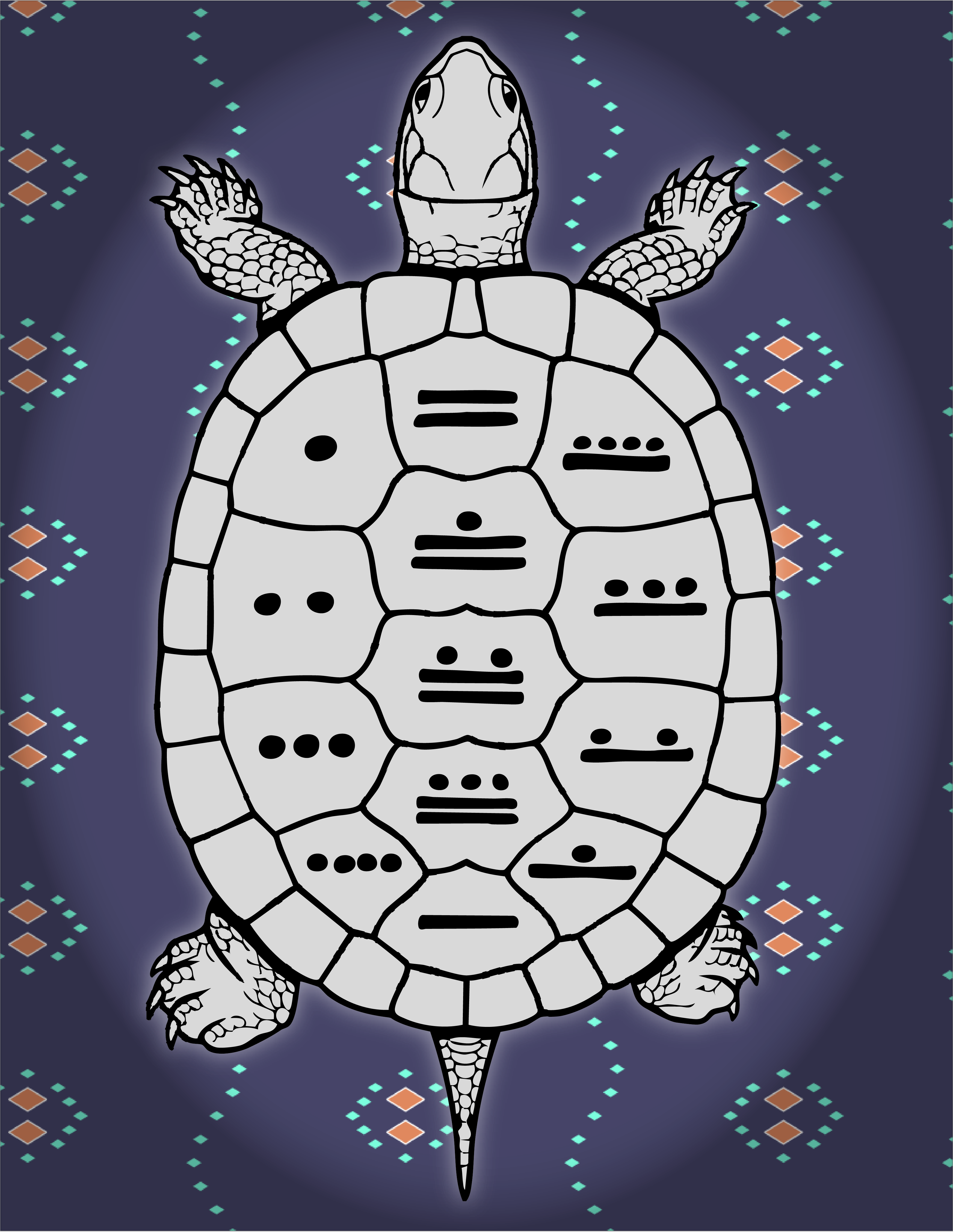
While the Day Sign describes the archetypal identity, the Tone defines the intention behind it. To the Ancient Maya, numbers were governed by a specific Maya Deity that complements the day sign. This is why ancient inscriptions often depict numbers as Head Glyphs or portraits of the gods themselves.
In other contexts, the Tones appear as simple bar-and-dot numerals (dots representing ones, bars representing fives). This count of 13 is reflected in the natural world. As illustrated here, the turtle naturally possesses 13 main scutes (scales) on its shell, a biological pattern that identifies the creature as a living calendar in various Indigenous American traditions. This same rhythm governs the sky. While the solar and lunar counts do not sync, the sun's annual journey invariably spans across 13 distinct lunations.
Each day, the tone increases by one. If today is a Tone 4, tomorrow will be a Tone 5. Together with the glyphs, they create a spiral of time that ensures no two days are exactly alike within the 260-day cycle.
- Tones 1–4: Establishing the foundation and defining the form (low intensity days).
- Tones 5–9: Taking action, expanding, and centering the energy (medium intensity days).
- Tones 10–13: Manifesting, perfecting, and returning to the source (high intensity days).
A Unified Mesoamerican System
The 260-day Tzolkin is a system shared by cultures throughout Mesoamerica, from the ancient Olmec to the Maya, Zapotec, Mixtec, and Aztec. While a few names and interpretations varied, the system itself was universal and, most importantly, the count was continuous and unbroken. Ancient Maya, contemporary Maya daykeepers, and historical Aztec records align with the same correlation (the GMT). '4 Ajaw' in ancient Tikal is the same '4 Ajaw' today.
This unity also extended to the solar calendar. All cultures used a 365-day Haab' calendar, structured as 18 months of 20 days, followed by a 5-day transitional period (the Wayeb'). They were all acutely aware that this 365-day count was slightly "fast" compared to the true solar (tropical) year of ~365.2422 days. They observed this discrepancy as the Haab' "drifted" against the seasons; for example, the date of the winter solstice would shift forward by one day every four years.
Crucially, these cultures did not change the solar calendar to correct for this drift, instead allowing the Haab' to drift through the seasons in order to maintain a continuous count. However, regional variations in the Haab did emerge. During the Classic period, Tikal's calendar was the standard. By the Late Classic, a 1-day shift was observed in Campeche (a correlation later seen in Aztec records). By the Postclassic period, the Yucatan Maya observed a further 1-day shift, placing them 2 days offset from the original Tikal standard. This site uses the Tikal standard, which aligns with the classic Maya Haab count.